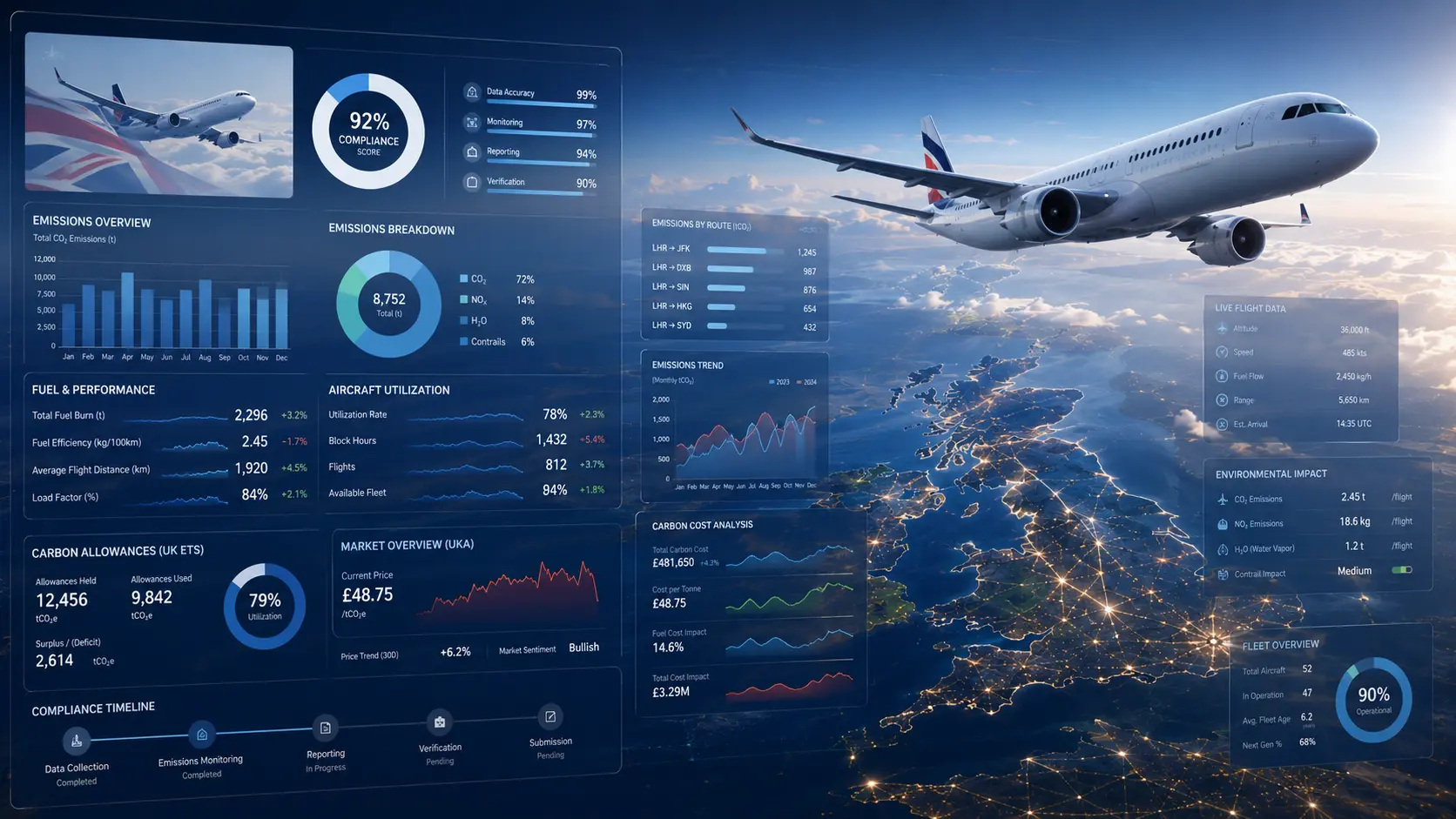
Since the United Kingdom’s departure from the European Union, aircraft operators flying within and from the UK have been subject to a separate carbon market known as the UK Emissions Trading Scheme (UK ETS).
While the UK ETS was initially designed to mirror many aspects of the EU ETS, it has evolved into an independent regulatory framework with its own requirements, authorities, and compliance obligations.
For aircraft operators, understanding the UK ETS is essential for managing emissions reporting obligations, carbon costs, and overall environmental compliance.
Prior to Brexit, UK aviation activities were regulated under the European Union Emissions Trading System (EU ETS).
Following the UK’s withdrawal from the European Union, the UK ETS was established on 1 January 2021 to replace the EU ETS for activities falling within UK jurisdiction.
The scheme forms a central component of the UK’s strategy to achieve net-zero greenhouse gas emissions by 2050.
Like the EU ETS, the UK ETS operates under a "cap-and-trade" mechanism.
A cap is placed on the total quantity of greenhouse gas emissions allowed from covered sectors. Aircraft operators must surrender allowances equivalent to their verified emissions each year.
Operators that reduce emissions can lower their compliance costs, while those with higher emissions may need to purchase additional allowances through auctions or the secondary market.
Aviation remains one of the most challenging sectors to decarbonize.
By incorporating aviation into the UK ETS, the UK Government aims to:
- 1Encourage fuel efficiency improvements
- 2Promote operational efficiencies
- 3Support the adoption of sustainable aviation fuels
- 4Reduce overall carbon emissions from aviation activities
The scheme also helps ensure that aviation contributes to the UK’s broader climate objectives.
Operators within scope are required to:
- 1Maintain an approved Monitoring Plan
- 2Monitor fuel consumption and emissions
- 3Submit Annual Emissions Reports
- 4Obtain independent verification
- 5Surrender UK ETS allowances annually
Failure to comply can result in significant penalties and regulatory enforcement actions.
Many operators are subject to multiple environmental schemes simultaneously.
Depending on routes and operations, aircraft operators may need to comply with:
- 1UK ETS
- 2EU ETS
- 3CORSIA
- 4ReFuelEU Aviation
Understanding how these frameworks interact is essential to avoid reporting errors and compliance risks.
As climate policies continue to evolve, aviation operators face increasing pressure to strengthen emissions management and sustainability reporting processes.
The UK ETS is expected to continue developing alongside broader UK climate initiatives, creating new opportunities and challenges for aircraft operators.
In our next article, we will examine which flights and operators fall within the scope of the UK ETS and explain the key exemptions and applicability thresholds.
Emissence supports aircraft operators with UK ETS Monitoring Plans, emissions reporting, verification readiness, and ongoing compliance management.
Whether you are navigating UK ETS requirements for the first time or seeking to improve your existing compliance programme, our specialists can help.
Contact us at [connect@emissence.com](mailto:connect@emissence.com) to discuss your UK ETS compliance requirements.