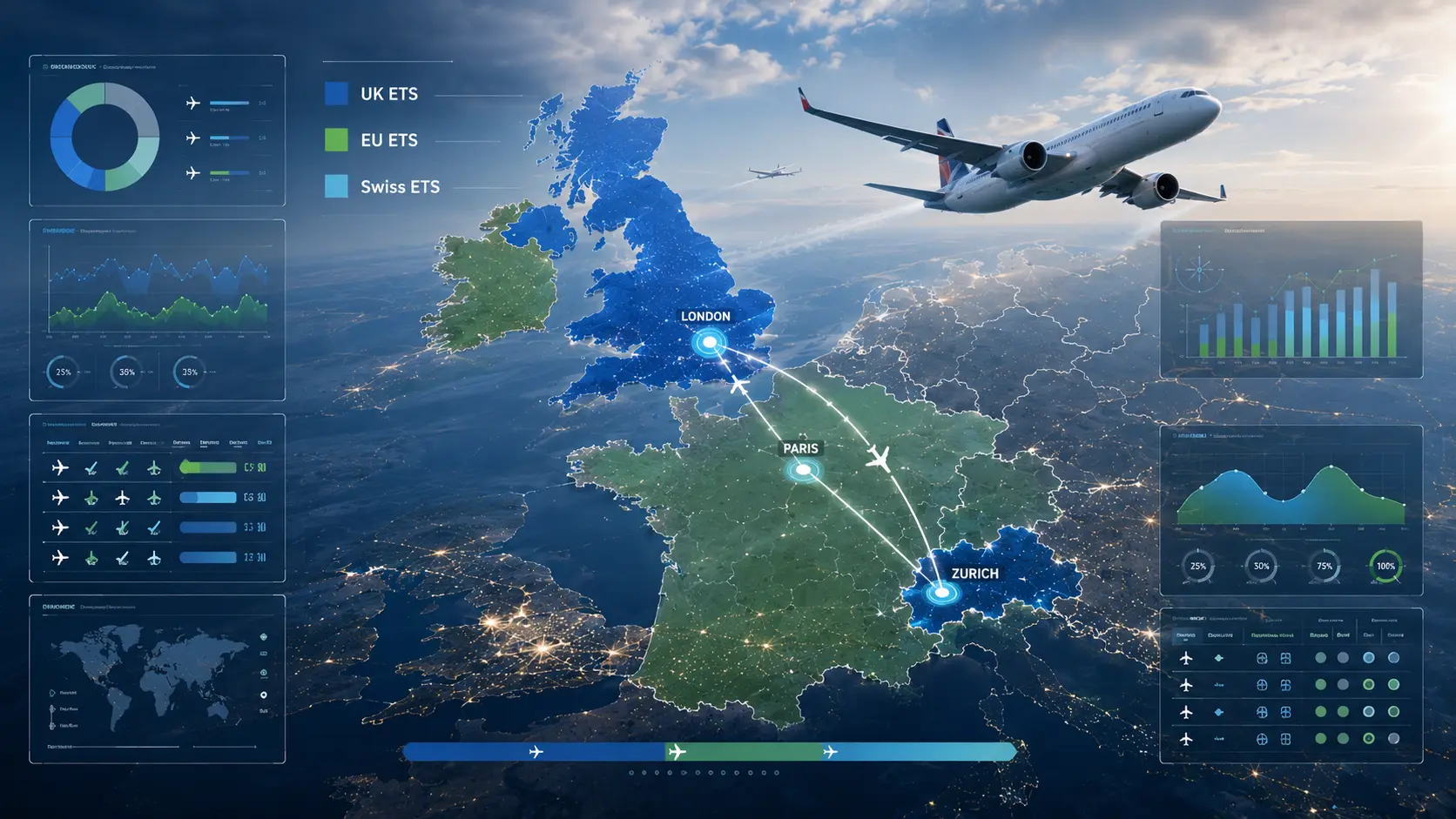
Since the United Kingdom’s departure from the European Union, aircraft operators have had to navigate a separate emissions trading scheme alongside existing European and international environmental regulations. The United Kingdom Emissions Trading Scheme (UK ETS) now plays a central role in aviation carbon compliance for operators conducting flights involving the UK.
Understanding the scope of the UK ETS, how it interacts with the EU ETS and Swiss ETS (CH ETS), and the obligations it creates is essential for effective compliance management.
The UK ETS was established on 1 January 2021 following the United Kingdom’s withdrawal from the European Union. It replaced participation in the EU ETS for activities falling under UK jurisdiction and serves as one of the UK’s primary tools for reducing greenhouse gas emissions.
Like the EU ETS, the UK ETS operates under a "cap-and-trade" principle. Aircraft operators must monitor emissions from covered flights and surrender allowances equivalent to their verified annual emissions.
The scheme creates a financial incentive for operators to improve fuel efficiency, reduce emissions, and support the transition toward more sustainable aviation.
Aviation remains one of the most difficult sectors to decarbonize due to its reliance on liquid fuels and long aircraft lifecycles.
The inclusion of aviation within the UK ETS aims to:
- 1Encourage emissions reductions
- 2Support sustainable aviation fuel adoption
- 3Promote operational efficiencies
- 4Contribute to the UK’s net-zero objectives
For many operators, carbon compliance has become an important operational and financial consideration.
The UK ETS currently applies to emissions from several categories of aviation activity.
Flights between airports located within the United Kingdom.
- 1London Heathrow – Manchester
- 2Edinburgh – Birmingham
- 3Belfast – London Heathrow
Flights departing from the United Kingdom and arriving at airports located within the European Economic Area (EEA).
- 1London Heathrow – Paris
- 2Manchester – Amsterdam
- 3London Gatwick – Dublin
Flights departing from the United Kingdom and arriving in Switzerland.
- 1London Heathrow – Zurich
- 2Manchester – Geneva
Flights between the United Kingdom and Gibraltar also fall within the scope of the UK ETS.
One of the most common areas of confusion concerns flights between the UK and Europe. The applicable scheme depends on the direction of travel.
- 1London → Paris = UK ETS
- 2Paris → London = EU ETS
- 3Manchester → Amsterdam = UK ETS
- 4Amsterdam → Manchester = EU ETS
- 5London → Zurich = UK ETS
- 6Zurich → London = CH ETS
As a result, a return service between London and Paris may generate obligations under both the UK ETS and EU ETS.
Similarly, a return service between London and Zurich may generate obligations under both the UK ETS and CH ETS.
Operators must therefore ensure emissions are allocated correctly when preparing annual reports.
The UK ETS applies to aircraft operators conducting covered aviation activities regardless of nationality.
- 1Scheduled passenger airlines
- 2Cargo operators
- 3Charter operators
- 4Business aviation operators
- 5Corporate flight departments
A non-UK operator conducting flights within UK ETS scope may still have UK ETS compliance obligations.
Certain operators may qualify as small emitters and benefit from simplified monitoring requirements.
An operator generally qualifies if:
- 1Annual emissions from covered flights are below 25,000 tonnes CO₂
- 2The operator performs fewer than 243 flights per four-month period during three consecutive four-month periods
Operators should confirm eligibility with their administering authority.
Several aviation activities remain exempt from the UK ETS.
- 1Military flights
- 2Customs flights
- 3Police flights
- 4Search and rescue operations
- 5Firefighting missions
- 6Humanitarian flights
- 7Emergency medical flights
Flights conducted by aircraft with a maximum certificated take-off mass below 5,700 kg are also generally excluded.
Operators must have an approved Monitoring Plan describing how emissions are monitored and reported.
Fuel consumption data must be collected and maintained throughout the reporting period.
Operators must prepare and submit an Annual Emissions Report containing verified emissions data.
Reports must be verified by an accredited verifier before submission.
Operators must surrender allowances equivalent to their verified emissions by the applicable compliance deadline.
Many operators are now simultaneously subject to multiple environmental frameworks.
Depending on their route network, operators may need to comply with:
- 1UK ETS
- 2EU ETS
- 3CH ETS
- 4CORSIA
- 5ReFuelEU Aviation
- 6Non-CO₂ Aviation Effects MRV
Managing these overlapping requirements requires robust monitoring systems and strong data governance processes.
The UK Government continues to develop its emissions trading framework as part of its wider climate strategy. Future developments may include enhanced sustainability requirements, greater support for sustainable aviation fuels, and further integration with net-zero objectives.
Operators that establish effective compliance programmes today will be better positioned to adapt to future regulatory changes.
The UK ETS has become a key component of aviation environmental compliance for operators conducting flights involving the United Kingdom. While the scheme shares many similarities with the EU ETS, its scope and interaction with EU ETS and CH ETS require careful consideration.
Understanding route applicability, maintaining accurate emissions data, and preparing for verification are essential for successful compliance. As carbon costs continue to increase and sustainability expectations evolve, effective UK ETS management is becoming both a regulatory necessity and a strategic business priority.
Emissence supports aircraft operators with UK ETS applicability assessments, Monitoring Plans, emissions reporting, verification readiness, and ongoing compliance management.
Whether you are entering the scheme for the first time or seeking to improve existing compliance processes, our specialists can help you navigate UK ETS requirements efficiently and confidently.
Contact us at [connect@emissence.com](mailto:connect@emissence.com) to discuss your UK ETS compliance requirements.