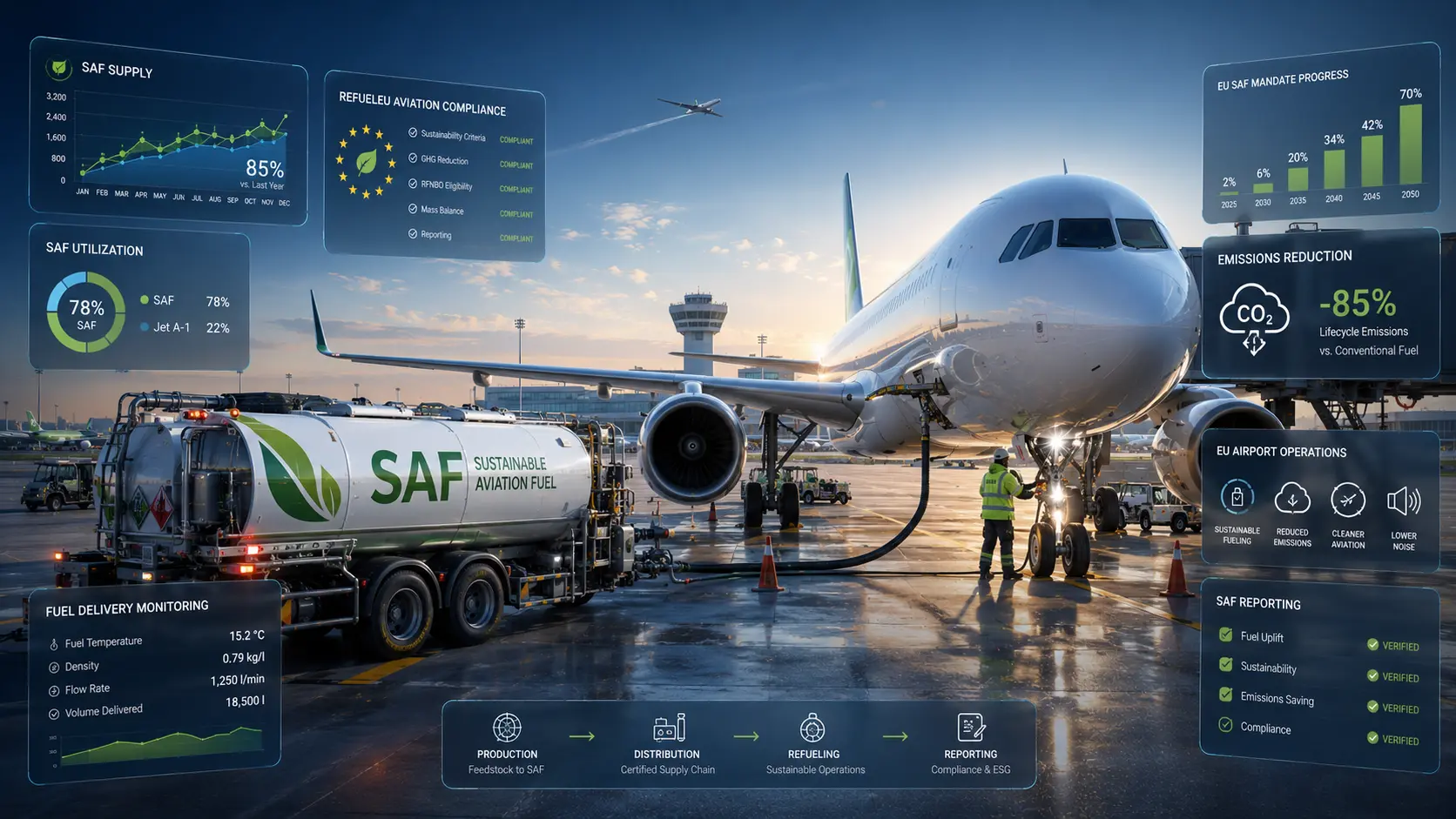
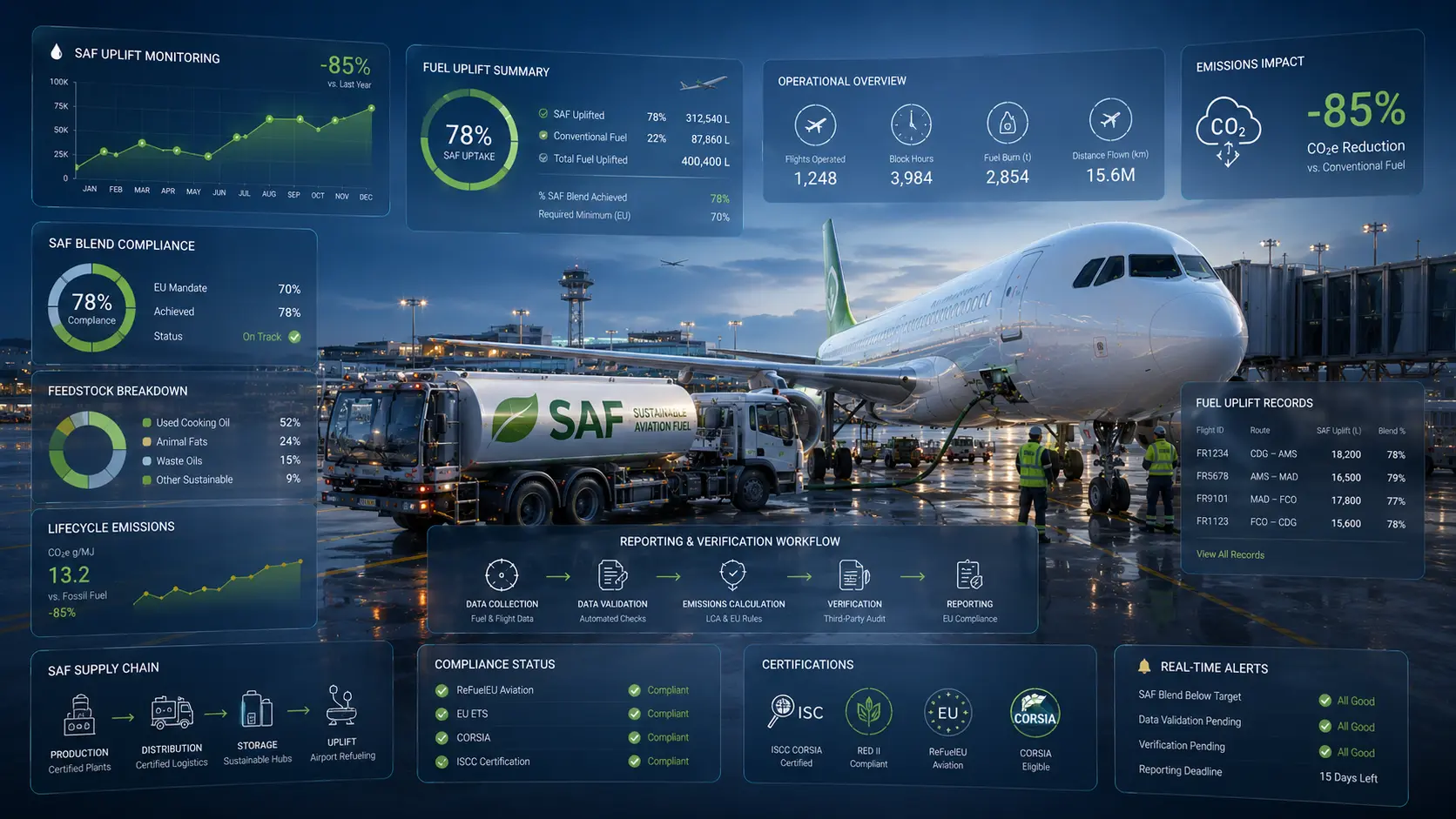
The aviation industry faces increasing pressure to reduce greenhouse gas emissions and accelerate its transition toward more sustainable operations. While carbon markets such as the EU ETS and global initiatives like CORSIA address emissions through market-based measures, the European Union has introduced a complementary regulation focused directly on fuel usage: ReFuelEU Aviation.
As part of the European Green Deal and the Fit for 55 package, ReFuelEU Aviation aims to increase the use of Sustainable Aviation Fuel (SAF) across Europe and reduce the sector's dependence on conventional fossil jet fuel.
For airlines operating within Europe, understanding ReFuelEU Aviation is now an essential component of environmental compliance.
ReFuelEU Aviation is Regulation (EU) 2023/2405, adopted by the European Union to stimulate the production, supply, and uptake of Sustainable Aviation Fuel.
The regulation establishes mandatory SAF blending requirements for aviation fuel suppliers and introduces obligations for aircraft operators to support the efficient use of sustainable fuels across the Union.
The ultimate objective is to reduce lifecycle greenhouse gas emissions from aviation while supporting the development of a competitive SAF market.
One of the biggest barriers to aviation decarbonization is the limited availability and higher cost of sustainable aviation fuels.
Without regulatory intervention, SAF adoption would likely remain slow due to supply constraints and economic considerations.
ReFuelEU Aviation addresses these challenges by creating predictable demand, encouraging investment in SAF production capacity, and reducing the risk of uneven implementation across Member States.
The regulation establishes progressively increasing SAF blending mandates.
Fuel suppliers must ensure that aviation fuel made available at Union airports contains a minimum share of SAF.
These requirements increase gradually over time, providing the industry with a clear roadmap for decarbonization while allowing markets to adapt.
Eligible Sustainable Aviation Fuels include certain:
- 1Advanced biofuels
- 2Synthetic aviation fuels (e-fuels)
- 3Recycled carbon aviation fuels
Only fuels meeting the sustainability and greenhouse gas reduction criteria established under EU legislation qualify toward ReFuelEU targets.
Although the primary blending obligation falls on fuel suppliers, aircraft operators have important responsibilities under the regulation.
Operators must:
- 1Monitor fuel uplift activities
- 2Report annual fuel consumption data
- 3Demonstrate compliance with minimum refuelling requirements
- 4Participate in annual reporting and verification activities
For many airlines, ReFuelEU introduces entirely new data collection and reporting obligations.
ReFuelEU Aviation complements existing frameworks including:
- 1EU ETS
- 2UK ETS
- 3CORSIA
- 4Non-CO₂ Aviation Effects MRV
Together, these initiatives form part of the European Union’s broader strategy for aviation decarbonization.
As SAF mandates increase and reporting requirements mature, ReFuelEU Aviation is expected to become one of the most significant sustainability regulations affecting European aviation.
Aircraft operators that establish robust fuel monitoring and reporting systems today will be better positioned to meet future requirements efficiently.
In our next article, we will examine which aircraft operators are subject to ReFuelEU Aviation, the applicability criteria, and the key exemptions provided under the regulation.
Emissence supports aircraft operators with ReFuelEU Aviation monitoring, reporting, verification readiness, data management, and regulatory advisory services.
Whether you are preparing your first ReFuelEU report or strengthening your compliance programme, our specialists can help.
Contact us at [connect@emissence.com](mailto:connect@emissence.com) to discuss your ReFuelEU Aviation requirements.